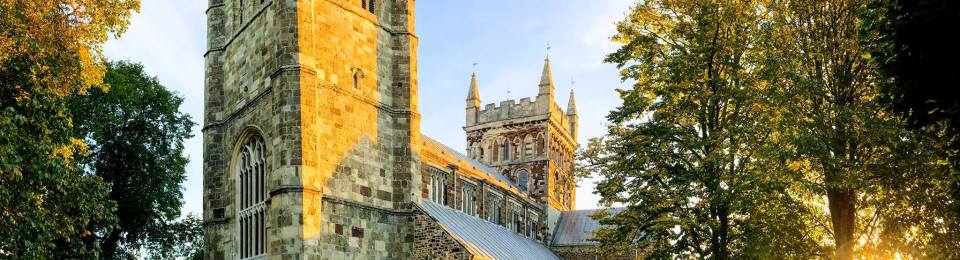
Do you ever have free time and don’t know what to do with it? Too many choices; no good reason to choose any one activity or place to visit. If you’ve read that classic The Dice Man, you could let the die decide. No die? Then a whim can be your friend. Choose something apparently at random and go with it. Commit to it without expectation, doubt or regret. It’s true we all like to make predictions. We find it hard not to. But it’s good to recognise these are often as unhelpful (eg part of making ourselves anxious) as they are wrong.
No point being in two minds. You never know what you will find or what might happen.
Last week our inexplicable whim was to choose Wimborne, only becoming aware later of the unintended pun.
Wimborne is a medieval town in southern Dorset dominated by its Minster which gives its name to the full version by which the town is known, Wimborne Minster.

We arrived and parked. What to do now? We had to choose. Before we had time to consider alternatives, we heard the Minster’s bells tolling. They were loud. Not something that we could easily ignore. It could have felt as if our choice was being made for us. But we decided to visit the Minster.
A lucky happenchance: It turned out the bells were ringing a peal known as the 5001 Stedman Cinques lasting some 3 and a half hours to celebrate the Harvest Festival. A different esoteric world with its rounds, call changes, and the importance of learning ropesight. A world we knew nothing about before and still no little of. The Minster bells have been calling the Faithfull to prayer for more than six centuries.
We set off following the sound of the bells through the ancient, winding streets that at times seemed unplanned and haphazard. At times we seemed to be moving towards the sound and at others as if we were being chased by it.
The Minster itself is full of history and architectural and other features. One that we found most unusual is the very rare, chained library, one of the first public libraries in England opening in 1686. The books are chained because, being so hard to produce they were very valuable. The oldest book is from 1343 which encouraged readers to avoid spiritual pitfalls. There are works in Greek, Latin and Hebrew handwritten on lambskin. There is also a 14th century astronomical clock. The Minster is also the final resting place of King Ethelred, brother of Alfred the Great and of Isaac Gulliver the notorious and very wealthy smuggler who ruled much of the South West in the eighteenth century.
A few days after our visit to Wimborne by chance I was listening to a repeat of Justin Welby talking to actor Gabriel Byrne (https://www.linkedin.com/groups/53475/ ). He has been prolific as an actor and been very successful. While he talked about a lot of interesting things, one that resonated with my interest in our choices of active or passive ways of describing our experiences was what he had to say about visiting a church. Coming so soon after our trip to Wimborne Minster this naturally reminded me of our visit.

Gabriel Byrne; “how powerful the building of the church actually is. Because it’s not just a place…..in its way it’s a repository for all the yearnings and the longings and the fears and joys throughout the centuries that are trapped in the stone and the glass……I like to go and sit in a church where the silence is trapped inside….to feel the history in the walls and the glass of the church and from the altar and so forth can be, even for an agnostic or an atheist like me, tremendously comforting.”
Undoubtedly many would find this interesting if not poetic.
Whether visiting a church is your bag or not is down to you. This raises the question of how any of us fill our ‘bags’? We have little idea. But we can guess it’s a fascinating mixture of our aims and ambitions, likes and dislikes, hopes and fears, and our values. The way we understand how the world works and what it is to be human are another important part. All these accumulated, often haphazardly, against a background of past experiences and social influences. They are essentially choices we have made, mostly without realising we have done anything, but some consciously made.
All of this accumulated ‘stuff’ is what we take with us into a church or anywhere else. The stones do not actually talk to us. The yearnings and longings of centuries past are not trapped in the stones and the glass; neither is the history is in the walls and the glass; the power is not in the building.
Much of the time most of us describe our experiences like Gabriel, albeit less eloquently. We talk as if our experience is given to us by the situations and circumstances of our lives; the ‘stones’ or the history trapped in the walls’. But when we talk like this, we are missing something important. If it is just the stones talking to us, then they would say much the same thing to all of us. But each of us will have our very individual experience created unknowingly from the ‘stuff’ we carry with us, the accumulated ideas and associations that lie somewhere in the bottom of our ‘bags’. When we walk into a church, we cannot help bringing our ‘stuff’ with us. If you read about Gabriel Byrne’s life and his book Walking with Ghosts you will get some idea of his ‘bag’.

? on a whim
If you like this and would like more, help me keep going with a donation of a cup of tea ….. and, perhaps a biscuit
£2.00
There are an infinite number of experiences we might have when visiting a church. Like Gabriel we might have a sense of tremendous comfort. Another might see the majesty of God, another the oppression and abuse by members of the church, another might focus on past attitudes to women and same sex unions. Another might see the great skill and craft that went into the building, while another might wonder at the expenditure and how else it could have been spent.
How we think our experiences work, matters. Thinking it’s the ‘stones’ or the ‘history in the walls’ sees us as passive receivers. The consequences of using these passive explanations is massive. Taking a wider view, it supports the increasing levels of felt helplessness, the proliferation of diagnoses of conditions and disorders we suffer from, the rising tide of mental health problems especially among the young, the use of drugs prescribed and non-prescribed to avoid bad feelings or achieve a high, and perhaps the increasingly divisive nature of public debate.
But we are anything but passive receivers. Our experiences flow from our choices and our active, if partly unconscious, perception of our surroundings. Sometimes they flow from a mere whim, but it is still an active choice.
Don’t think I am criticising Gabriel Byrne I am not. I found what he had to say very interesting. I have focused only on a small part of it. You might not like or be interested in what he had to say. It might not be your bag. It was mine. Because of the culture we live in it is all but impossible to avoid passive forms of expression. but it makes a difference when we can. Earlier I highlighted in bold the active forms that could have been expressed in more poetic passive forms.
TAKEAWAY: You always take your unique, active presence, both conscious and unrecognised, into every situation. You cannot do otherwise. It is this that shapes the nature and quality of your experiences.
 InToMinds