
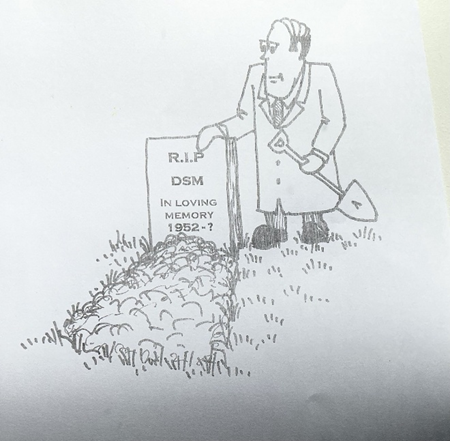
In 1962 Thomas Kuhn published The Structure of Scientific Revolutions. He proposed that science moves forward in jerks through paradigm shifts. He noted that paradigm shifts are not necessarily accepted just because of a new scientific discovery or theoretical framework; they are frequently resisted by those who are invested in the old paradigm. Change happens slowly and depends to some extent on new people entering the field. Social sciences may be more complex as they are more dependent on value-based, ideological positions but they follow similar shifts.
Mental health is a particular case. Two hundred years ago possession by demons and moral failure were the preferred explanations. For the last almost two hundred years the medical model has become increasingly dominant. Illness, condition and disorder are now the preferred descriptions of ‘odd’ and distressed experiences. The proposed causes within the medical model are usually seen as biological together with the events and the circumstances of our lives. The rise of the medical model has been driven by the almost full acceptance and institutionalisation of the DSM (Diagnostic and Statistical Manual of Mental Disorders).
Will there ever be a paradigm shift in a system that has become so accepted and woven into mindsets and practice? For a long time there have been some voices offering an alternative to the medical model. It’s difficult to say if there are more today but I have the impression they may at least be more organised. Their focus is on depathologising mental health problems. They argue that treatment needs to be reclaimed within a psychological framework.
As Kuhn pointed out paradigm shifts are often resisted by those who are invested in the old paradigm. So, who is invested in the medical model? Who has the power? Where are the incentives? Are there winners and losers?
In terms of incentives, three of the most universal incentives that drive behaviour for many people are money, power and status. From this perspective there are many professions, practitioners, pharmacological companies, trainers, insurers, within the mental health system who are heavily invested in the system as it is.
Virtually all messages about mental health emphasise the need for treatment. Even those arguing for depathologising mental health do so. This relentless emphasis on the need for treatment undoubtedly creates the need for services. There are arguments about whether this is good or bad, but does this constant messaging about treatment tell us more about incentives?
The constant emphasis on the need for treatment is one means by which the mental health professions have been able to thrive. Society has conceded them the power to define and cultivate categories of disability and need that only they, through their certified training, can provide. This is presented as in our best interest and supported by a narrative of evidence-based research within the DSM framework.
None of this discussion should be read as meaning we do not need help and support to deal with our problems of living. But where could this help come from and how could it be ‘delivered’? It can be argued that one unforeseen consequence of the expert mental health system is that it undermines the confidence of parents, relatives, friends, neighbours to help each other. It also makes each of us less able to help ourselves. Ivan Illich in his Disabling Professions argued in 1977 that the age of the professions was coming to an end. He was being optimistic. Since then, the professions have simply expanded. We are now even more in thrall to experts of all kinds.
Could there ever be a paradigm that frees us from the DSM and its medical model. A paradigm that does not suggest we’re forever the victims of our biology, our past, or our upbringing. A paradigm that empowers us to understand the richness and complexity of our normal psychological processes; that emphasises our ability to support each other rather than the need for treatment; that explores the ordinary and normal range of what our emotions can feel like without seeking to define some as abnormal; that reinforces our sense of agency and responsibility; a paradigm shift in the culture that sees us as active, sense-making agents; that sees our sense making as at the centre of experiences and of our distress and unhappiness? What might such a paradigm shift look like? What would be needed?
To answer this, we must first look at one aspect of how the medical model works.
The paradigm of the medical model looks for signs and symptoms to diagnose illness and disorder. Within mental health our feelings are regarded as symptoms. This is a critical issue. With increasing messaging on mental health problems, individuals have become more sensitised to certain feelings (eg anxiety). They have been ‘taught’ to be more concerned with them and to see them as potential symptoms of disorder. Diagnostic inflation is not a result of malingering, but of this increased sensitivity. More awareness campaigns about disorders will simply lead to more people genuinely believing they have a problem; diagnostic inflation will continue.
Could a new paradigm involve a cultural shift in how we understand, judge and react to our feelings?
Feelings arise because we are sense makers. We are concerned with how things might be for us. We predict bad things might happen; we are sad and disappointed that things have not turned out as we’d hoped; we regret mistakes we have made; we remind ourselves of the bad things that have happened; we worry others may judge us badly; we judge ourselves negatively in comparison with others; we wonder if we are different from others. (This is by no means a complete list).
We all do these things sometimes and by doing them we inevitably make ourselves distressed. The more intensely we do it ……
“Sometimes I want to murder time, sometimes when my heart’s aching.” Incredible String Band, October Song 1966
Will there ever be a paradigm shift away from the use of the medical model in mental health? What first steps could be taken?
Could a radical shift in public mental health messaging promote greater psychological literacy?
Could public and schools’ programs emphasise the complexity and richness of the normal psychological processes all of use to make sense of our world? Could we be encouraged to become more aware of the fine detail of our thinking; to recognise how the choices we are continuously making are at the root of our emotions; that feelings are a reflection of the thinking we are doing at the time; that it is not helpful to see them as symptoms. It matters what we choose to focus on, the expectations we have; our hopes and fears; the predictions we make; what we choose to remember and what forget; what we make important and what we discount; how we are influenced by those in our social context and the wider culture. AI cannot yet match the nature and complex detail of the processing we are doing as we go about our daily lives.
GPs have a key role to play. As individuals many of us might need support at various times. Could this be offered within a framework that allows the person to understand their distress in terms of normal psychological processes? Referral to services could be short-term and the reasons could be described in terms such as “normal distress response” and “context-related emotional reaction”, “adjustment reaction”, rather than illness or disorder. Telling someone they have a disorder not only stops them from seeing how their thinking has shaped their experience, but more importantly it often acts as a life sentence of limitation and disability.
Longer consultations in Primary Care for presentations involving psychological difficulties would allow GPs to have fuller discussions with patients. Further training could be provided for GPs in psychological formulation.
Psychotropic medication may still be helpful in some situations. GPs could present it as a time-limited aid, rather than as a ‘treatment’ for a disorder. It would also be helpful to have clear deprescribing guidance and follow-up pathways from the outset.
Could such a paradigm shift come about?
Two hundred years ago we believed in possession by demons and moral failure. There may be parts of the world where this is still the case. Change within such a complex cultural area is always going to be slow. Vested interests will resist. Could governments make a difference by setting radical new policy guidelines?
My book ‘The Origin of Anxieties’ describes how both day-to-day feelings of anxiety and ‘anxiety problems’ can be understood in terms of the ordinary psychological processes that all of use to make sense of the world. We are drawn into ‘anxiety problems’ partly because the medical model encourages us to view our anxious feelings as symptoms of a condition or disorder that we ‘have’. It doesn’t have to be this way; we need to help each other shift our focus from our bad feelings to the bad thinking that causes them. The book is on Amazon; lots of people find it frees them from old stigmatising ways of thinking.
 InToMinds